 2026-09-15
 You can replace an SPI NOR flash chip with a different part, but matching capacity and package is not enough to establish compatibility. The replacement must work with the board’s electrical connections and with the commands, settings and startup sequence used by its firmware.
Perhaps the original part is unavailable. Perhaps a supplier has offered another chip with the same memory size and eight pins. Before ordering it, separate two questions: will it fit the board, and will the system actually work with it? Those are not the same check.
Start with the complete part numbers
Record the full ordering codes for the original device and the proposed replacement, including their suffixes. Then obtain the manufacturer’s datasheet for each. A shortened family name or a photograph of the top marking may not identify the package, voltage or temperature grade unambiguously.
Also establish what the memory does in your design. A chip used to boot a processor can face different compatibility constraints from one accessed by application software for data storage. If the boot ROM expects a particular startup behavior, changing an application driver later will not solve an earlier boot failure.
The SPI flash replacement checklist
| Check | What to compare | Why it matters |
|---|---|---|
| Supply and I/O voltage | Operating voltage ranges, input thresholds and any separate I/O supply. | A physically matching device may be electrically incompatible with the board. |
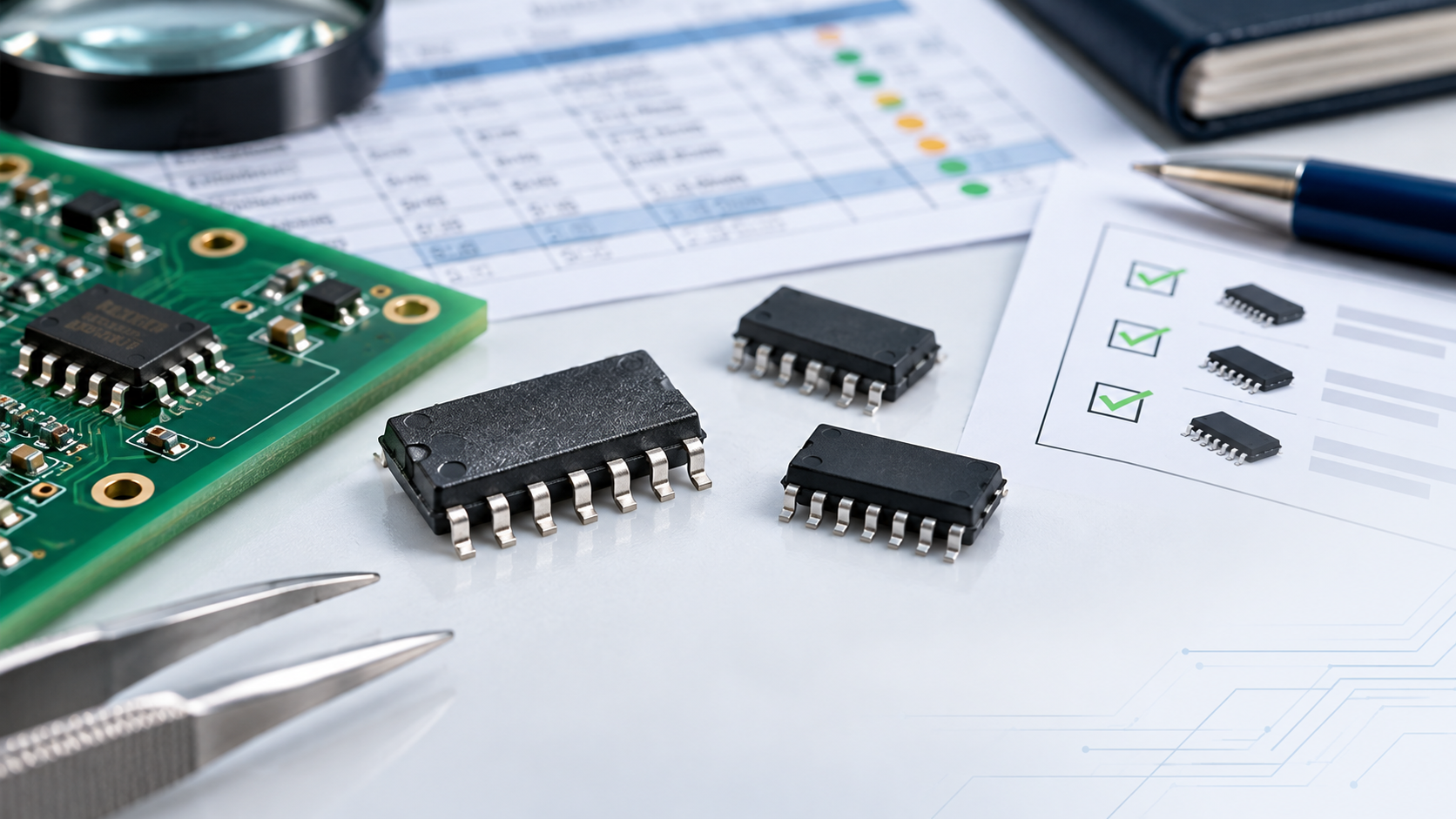
| Package and pin functions | Body dimensions, footprint, pin numbering and functions such as WP#, HOLD#, RESET# and extra data lines. | The same pin count does not establish the same connections or footprint. |
| Capacity and addressing | Required density, address length, address-mode entry and memory map. | A larger device is not automatically usable by existing firmware. |
| Read operations | Supported commands, bus modes, dummy cycles and clock limits. | The controller must issue a read sequence the replacement understands. |
| Erase and program operations | Page size, erase sizes, command codes, completion polling and maximum operation times. | Successful reading alone does not establish that updates or data writes will work. |
| Registers and protection | Quad-enable handling, register layouts, write procedures and protection behavior. | Register assumptions in old firmware may not apply to a different device. |
| Startup and reset | Power-up state, reset behavior, wake-up requirements and boot-controller support. | The flash must be in the state expected when the host first accesses it. |
| Operating requirements | Temperature range, endurance, retention and application-specific qualifications. | A functional sample may still be unsuitable for the intended service conditions. |
Use this as a screening checklist, not a substitute for a device-specific migration guide or qualification testing. Infineon, for example, publishes NOR flash replacement references with migration guidance, rather than treating a family-name match as sufficient.
Same size and eight pins: why that still is not enough
Consider a hypothetical board using a 3.3 V-class, 128-Mbit SPI NOR device. A candidate may also be advertised as 128 Mbit and supplied in an eight-pin package. If that candidate requires a 1.8 V supply, it is not a direct replacement on the unchanged board. Even after voltage matches, the exact package drawing and pin functions still need checking.
Do not confuse storage units either: 128 Mbit is 16 Mbytes. Check the units on supplier listings before comparing capacities. Buying more capacity does not remove the need to check the host’s addressing and firmware layout.
What if the replacement reads correctly but the board will not boot?
Reading a device ID with a programmer is a useful first test. It does not prove that the board’s boot sequence, Quad reads or firmware-update routine will work.
Look at the operations the host actually performs. Does it recognize the new device ID? Does it configure Quad operation correctly? Does it expect a particular address mode or read latency? Infineon’s QSPI and QPI mode guidance is an example of why interface labels alone are not enough to describe device behavior.
On Linux-based systems, check the actual kernel and driver version used by the board. The Linux SPI NOR documentation explains how SFDP information can support device discovery and where device-specific handling may still be needed. Support in a current upstream driver does not establish support in an older deployed system or its bootloader.
Test the operations the finished product will use
Before approving a replacement, work with your engineering team to test a non-production sample. Preserve any required original firmware and board-specific data before making changes.
The test plan should cover cold starts, resets, normal reads, erase/program operations, firmware updates and the operating conditions relevant to the product. Compare read-back data after programming. A board that starts once has passed one test, not the entire qualification process.
If the datasheet comparison exposes a firmware difference, describe the part as a candidate requiring changes and validation. Calling it a “drop-in replacement” before that work is completed can create problems for both purchasing and engineering.
Finding an ISSI part for your requirements
For an overview of the ISSI models listed on our site, see the ISSI memory IC selection guide. It includes product links for parts such as IS25WP080D-JNLE and IS25WQ040-JNLE-TR.
These are starting points for part-specific research, not an interchangeable-parts list. Compare the complete ordering code and manufacturer documentation against your original device before choosing a candidate.
Need a quote for the original or a candidate replacement?
Send EASYIEE the original manufacturer part number, required quantity and delivery requirements. If you are considering an alternative, include its full part number, the board’s supply voltage, package requirements and whether firmware changes are possible.
State whether you need the exact original part or are open to alternatives subject to engineering approval. This makes the sourcing request clearer without assuming compatibility that has not been tested.