 2026-06-22
 BOM Matching: How to Find Replacements for Shortage Microcontrollers & ICs
In today’s volatile electronics market, component shortages have become a major production blocker. When a critical microcontroller or integrated circuit (IC) goes out of stock or becomes obsolete, procurement teams must find a solution quickly. This is where a professional BOM matching service becomes essential.
BOM matching is not just about finding the exact part number; it is about identifying equivalents, drop-in replacements, or functional alternatives that allow your design to function without a total redesign. At EasyIEE, we specialize in helping OEM and EMS customers navigate these challenges through expert sourcing and technical verification.
Understanding the Core: What Needs Replacing?
Before searching for a replacement, it is important to understand the fundamental technology of the part you are replacing. For instance, if you are dealing with logic gates or processors, you might want to revisit our detailed guide on what an IC chip is and the principles of how integrated circuits work. Knowing the internal architecture helps in determining which parameters are “negotiable” and which are “critical” for your specific application.
Similarly, if your shortage involves control units, understanding the specific role of a microcontroller in your circuit is the first step toward finding a compatible alternative that won’t require a complete software rewrite.
The BOM Matching Process: 4 Critical Steps
1. Pin-to-Pin Compatibility Check
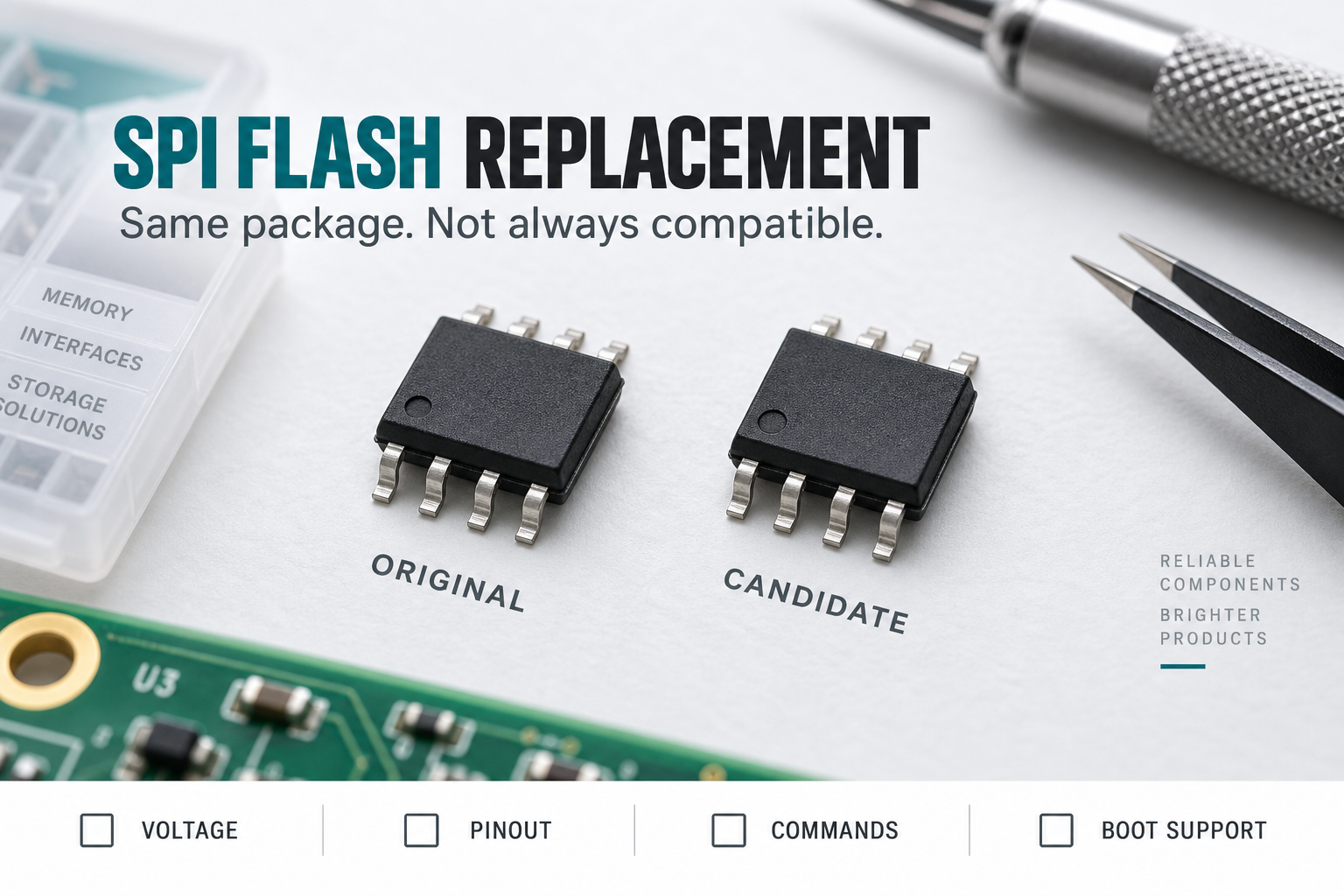
The “Gold Standard” of BOM matching is the drop-in replacement. This means the replacement part has the exact same pinout, package (such as LQFP, QFN, or BGA), and electrical characteristics. In many cases, specialized microcontroller suppliers can offer cross-reference tables to find these matches instantly, saving weeks of engineering time.
2. Functional Equivalence Verification
If a pin-to-pin match is unavailable, the next step is finding a functionally equivalent part. This requires a deep dive into the datasheet to compare:
- Core Architecture: (e.g., matching an ARM Cortex-M3 with a similar M4 core)
- Memory Size: Flash and RAM must meet or exceed the original specifications.
- Peripheral Sets: Ensuring the same number of UART, SPI, I2C, and ADC channels.
- Voltage Levels: Logic levels must be 100% compatible with the rest of your system.
3. Sourcing through Trusted Channels
Finding a theoretical part number is only half the battle. Securing physical stock is the real challenge. Working with a reliable electronic components distributor ensures that the alternatives you identify are actually available in the global supply chain, whether they are in Hong Kong, Shenzhen, or regional warehouses.
4. Engineering Testing and Validation
Never finalize a BOM replacement without rigorous testing. Even if the electrical parameters look identical, firmware behavior or timing nuances can differ between manufacturers. Always request samples for prototype validation before committing to a full production-scale purchase.
Struggling with a Component Shortage?
Upload your BOM list today. Our technical team will check global stock availability and suggest approved alternatives for your difficult-to-find parts.
Specialized Replacements: Optoelectronics and Discrete Parts
Shortages aren’t limited to high-end CPUs. Many industrial designs face critical supply issues with optocouplers and isolation amplifiers. If you are looking for alternatives in this category, it helps to review what optoelectronics are used for to ensure that the isolation voltage and switching speed of the replacement meet international safety standards.
For discrete components like diodes or transistors, the “BOM Matching” process is often faster, but parameters like gain (hFE) and breakdown voltage must still be meticulously checked against the original manufacturer’s specifications to prevent field failures.
How EasyIEE Facilitates BOM Matching
As a global sourcing partner, EasyIEE provides more than just a list of parts; we provide a comprehensive BOM sourcing service. Our process leverages a vast network of suppliers and a database of millions of manufacturer part numbers (MPNs) to:
- Identify End-of-Life (EOL) and obsolescence risks before they hit your production line.
- Suggest active replacements for discontinued components.
- Find shortage workarounds by sourcing from verified regional inventories.
- Provide traceability and quality inspection for all parts sourced through independent channels.
Conclusion
BOM matching is your best defense against production downtime. By combining a technical understanding of how microchips and ICs function with a robust supply chain partner, you can turn a supply crisis into a manageable procurement task.
If you have a bill of materials that is currently blocked by a few “hard-to-find” items, don’t wait for lead times to improve. Explore alternative matching and keep your production on schedule.
Frequently Asked Questions
What is a drop-in replacement in a BOM?
A drop-in replacement is an electronic component that can be used on an existing PCB without any changes to the hardware layout or software, as it shares the same pinout, package, and electrical specifications.
How do I find an equivalent for an obsolete IC?
You can search manufacturer cross-reference tools, consult with an independent distributor like EasyIEE, or use a BOM matching service that analyzes technical parameters to find current-production alternatives from other brands.
Does BOM matching include software/firmware compatibility?
While BOM matching focuses primarily on physical and electrical specs, technical sourcing teams can help identify if a replacement MCU has the same core and peripheral set. However, final firmware verification always requires engineering validation.