 2026-11-14
This guide explains what to check before purchasing or sourcing a servo drive system. It is written for procurement teams, maintenance buyers, OEMs, CEMs, and engineers who need to assess a drive, motor, or motion-control BOM. It does not assume that two units are interchangeable merely because their voltage, power rating, or connector shape looks similar.
What is a servo drive?
A servo drive receives command information from a controller and supplies controlled power to a servo motor. Its role is to help control motor position, speed, or torque according to the command and feedback from the system.
In a typical servo system, the encoder measures motion and returns feedback. The drive or motion controller compares the actual result with the command value and adjusts the motor output. This feedback-and-correction process is known as closed-loop control. OMRON’s technical guide on servomotors and servo drivers describes this relationship between the controller, drive, motor, encoder, and feedback loop.
A drive can therefore be central to machine accuracy, repeatability, alarm handling, and safe operation. But the drive alone does not define the final result. The motor, encoder type, mechanics, load profile, controller settings, and wiring also affect whether a system performs as intended.
Start with the machine task, not the drive label
Before comparing a servo motor drive or asking for a quote, define the motion task. The same drive family may have multiple variants for different input power, motor feedback, communication, safety, braking, and environmental requirements.
Start with these questions:
- Is the axis mainly controlling position, speed, torque, or a combination of these?
- What load is being moved, and does the load have high inertia, frequent starts and stops, or rapid direction changes?
- Is the application rotary, linear, indexing, synchronized multi-axis motion, or force-related control?
- Does the machine use an AC servo motor, a DC motor, or another motion architecture?
- What precision, repeatability, cycle time, and duty cycle does the process require?
These answers change the sourcing decision. A replacement that appears electrically similar may still be unsuitable if it cannot process the required feedback, accept the machine command format, support the needed operating mode, or handle the real load profile.
Servo drive and servo motor: what must be matched?
Servo drives and motors are usually selected as a working pair. A motor converts controlled electrical energy into motion, while the drive interprets commands and provides the appropriate output. The encoder or other feedback device helps the system correct deviations during operation.
For industrial servo systems, OMRON notes that the drive follows commands from the host controller and controls motor torque, speed, or position using inputs from the motion controller, feedback encoder, and motor. It also identifies communication, encoder feedback reading, and I/O processing as key functions of a servo drive. Read the technical reference.
When reviewing a servo motor and drive combination, verify at least the following:
| Item to verify | Why it matters | What to request before purchase |
|---|---|---|
| Motor model and feedback type | The drive must support the motor’s encoder or resolver interface and feedback format. | Motor nameplate photo, motor datasheet, encoder specification, and cable details. |
| Input supply and output rating | Supply voltage, phase, current, and output capability affect whether the system can operate safely. | Drive datasheet, input-power specification, continuous and peak current data. |
| Control mode | Position, speed, and torque control place different demands on the machine and controller setup. | Required operating mode and the existing controller configuration. |
| Command and communication interface | A compatible motor does not guarantee that the drive can communicate with the current controller. | Wiring diagram, controller model, fieldbus or pulse-command requirements. |
| Brake, regeneration, and protection requirements | High-inertia or rapid-stop applications may need specific braking and protection arrangements. | Machine cycle profile, braking configuration, alarm history, and original manual. |
| Mechanical installation | Connector orientation, cable length, mounting space, grounding, and cooling can block a practical replacement. | Photos, dimensions, connector details, and panel layout. |
Do not treat matching nominal voltage or motor power as proof of compatibility. It is only one part of the review.
How a servo drive system works in practice
A simplified control path is:
- A PLC, CNC, motion controller, or other host controller sends a target command.
- The servo drive interprets that command and calculates the required motor output.
- The power stage delivers controlled electrical energy to the motor.
- The motor produces rotary or linear motion through the machine mechanism.
- An encoder or other feedback device reports actual motion back to the control loop.
- The system corrects differences between the command and the measured result.
Festo’s overview of servo drives similarly describes a servo system as a real-time feedback arrangement involving a motor, controller, and encoder. The exact control architecture varies by machine. Some applications may use one or more control loops for torque, speed, or position rather than applying every loop in the same way.
Which servo drive parameters should buyers check?
When a quote request contains only “servo drive needed” or a partial part number, it is difficult to determine whether a proposed item is suitable. A stronger RFQ includes the parameters that change the sourcing decision.
For a servo drive system, include:
- Original drive manufacturer and exact model number;
- Original servo motor model number;
- Input voltage, phase, frequency, and supply arrangement;
- Continuous and peak current requirements, if known;
- Motor power, rated speed, rated torque, and encoder type;
- Required control mode: position, speed, torque, or another specified mode;
- Controller model and command method;
- Communication protocol or fieldbus requirement, if applicable;
- Brake resistor, regenerative unit, safety circuit, and alarm-interface requirements;
- Operating environment, duty cycle, ambient temperature, and cooling constraints;
- Required documentation, such as a datasheet, date code, certificate of conformity, or RoHS documentation.
If the requirement is a replacement for a failed drive, add photographs of the nameplate, connectors, wiring labels, alarm code, and the original manual page. Those details can prevent a proposal based only on an incomplete model number.
Key electronic components inside a servo drive
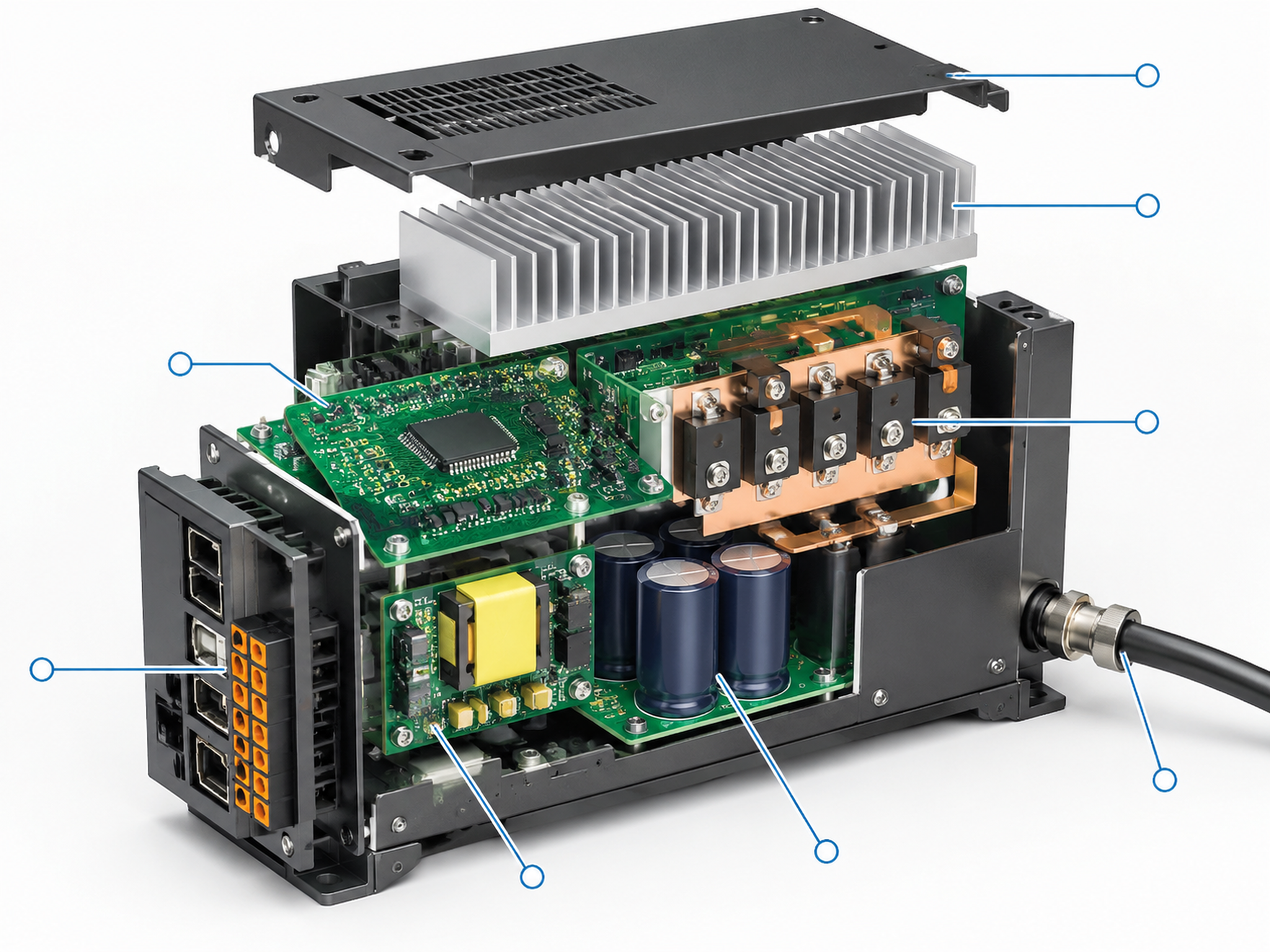
A servo drive is an assembled motion-control product, but its performance and repairability depend on multiple electronic component groups. The exact design varies by manufacturer and power class. For component-level sourcing, a buyer may need to identify not only the failed device but also the surrounding circuit and its electrical constraints.
- Control and driver ICs: used for control, signal processing, gate drive, interface functions, or related tasks depending on the design.
- Power semiconductors: used in the power-conversion stage. Their voltage, current, switching, thermal, and package requirements must be reviewed against the original design.
- Isolation components: may be used between control and power sections, depending on the drive architecture and safety requirements.
- Capacitors and passive components: can affect filtering, DC-link energy storage, timing, sensing, and power stability.
- Feedback and sensing devices: support current, voltage, temperature, speed, or position measurement, depending on the system.
- Connectors and cables: carry motor power, encoder feedback, control I/O, and communication signals.
For component sourcing, EasyIEE currently has public category pages for Driver ICs, Power Management ICs, MOSFETs, Optocouplers, Capacitors, Sensors, and Connectors. These category pages help identify component families; they do not by themselves confirm that a particular part is in stock, approved for a specific drive, or interchangeable with another part.
How to assess a replacement servo drive
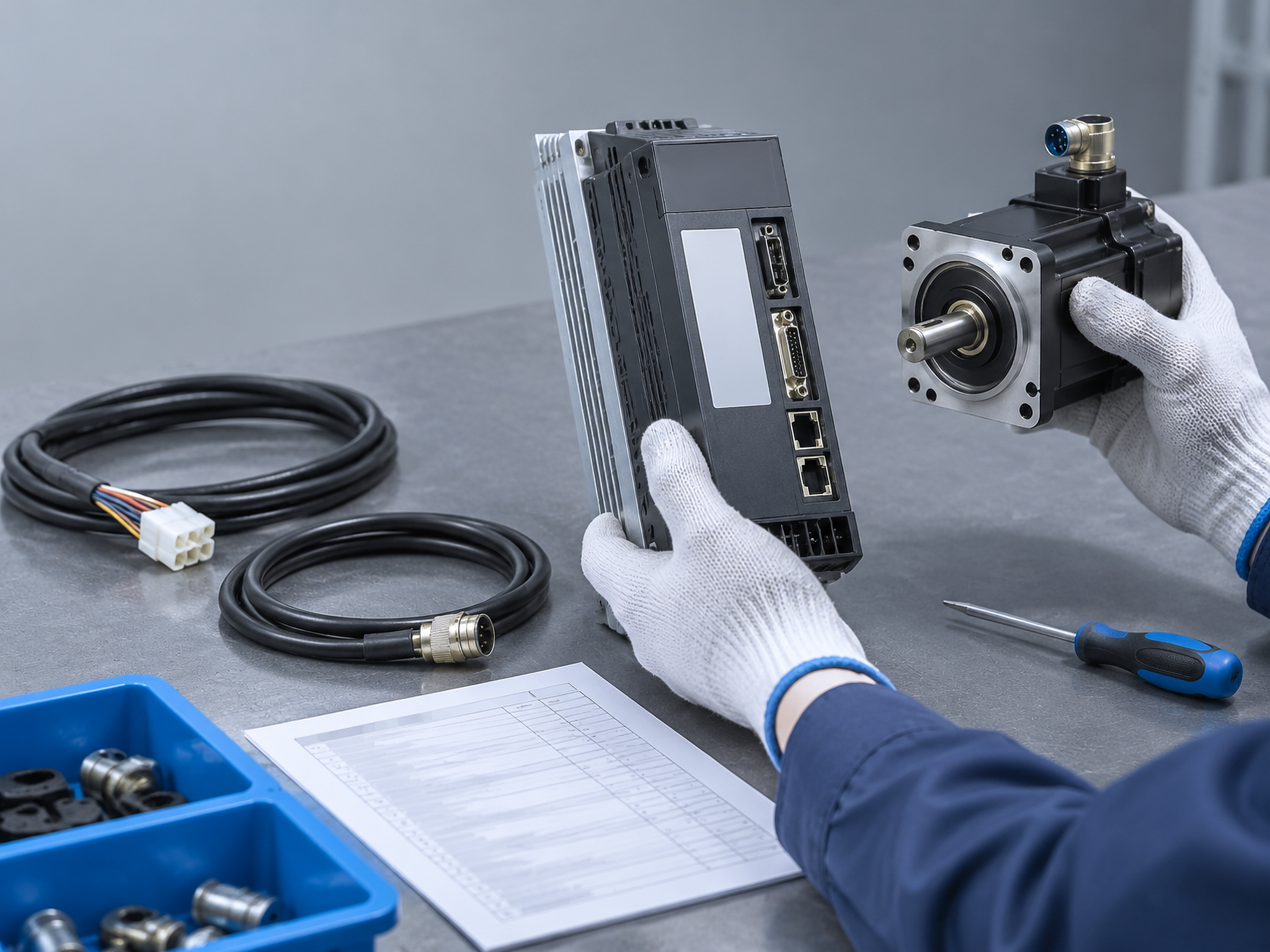
When the original servo drive is obsolete, unavailable, or under a long lead time, a replacement review should begin with evidence, not with a name that looks similar.
Use this sequence:
- Identify the original configuration. Record the full drive model, motor model, controller, encoder, software or parameter backup, and wiring arrangement.
- Separate confirmed facts from assumptions. A visible connector, nominal voltage, or similar model family is not enough to establish interchangeability.
- Check control and feedback compatibility. Confirm how the host controller commands the drive and how the motor feedback is read.
- Check electrical and thermal limits. Review the machine load, duty cycle, peak demand, braking needs, cabinet cooling, and protection requirements.
- Review commissioning impact. A new drive may require parameter setup, tuning, wiring changes, safety validation, or application testing.
- Document the acceptance plan. Define what must be tested before the machine returns to production.
This is procurement guidance, not a substitute for qualified engineering review. Safety functions, machine wiring, motion tuning, and protective circuits should be verified by personnel responsible for the equipment.
What to include in a servo drive RFQ or BOM inquiry
A good inquiry lets a supplier determine whether the request is for a complete drive, a replacement candidate, or component-level repair sourcing. It also reduces unnecessary back-and-forth.
For a servo drive sourcing inquiry, include:
- Exact manufacturer and part number, including suffixes;
- Required quantity and target delivery date;
- New, surplus, refurbished, or component-level requirement;
- Motor and controller model numbers;
- Photos of the label, connectors, and installed unit;
- Required documentation and compliance needs;
- Whether alternatives are acceptable and which parameters must remain unchanged;
- Known failure symptoms or alarm codes for repair-related component sourcing.
If your requirement concerns components used in a servo drive rather than a complete unit, submit the BOM or original part numbers with the required quantity, package, target date, and any documentation requirements through the EasyIEE RFQ and contact page.
FAQ
What is the difference between a servo drive and a servo motor?
A servo motor creates motion. A servo drive controls the electrical output to the motor based on commands and feedback. They usually work as part of the same servo system, together with a controller and encoder.
Can I replace a servo drive with another model that has the same voltage?
Not safely based on voltage alone. Confirm motor feedback, command interface, current capability, control mode, braking, safety, wiring, parameter setup, and machine testing requirements before accepting a replacement.
What does a servo drive control?
Depending on the application, a servo drive can control motor torque, speed, position, or a combination of these through a feedback-based control loop.
What information is needed to source components for a servo drive repair?
Provide the original component part number, package, quantity, drive model, board photographs, target delivery date, and any required documents. If a substitute is considered, identify the electrical and mechanical parameters that cannot change.