 2026-10-15
Searching for an electronic parts store near me usually means you need a component quickly. You may be repairing a control board, building a prototype or trying to keep an OEM production line moving. The challenge is that a nearby electronics shop may carry common parts, while the exact IC, MOSFET, memory device or connector you need may only be available through a technical distributor or sourcing supplier.
The most important step is not simply finding the closest store. It is confirming that the supplier can provide the correct manufacturer part number, package, quantity, availability and delivery information for your application.
What does “electronic parts store near me” usually mean?
The search phrase can refer to several different purchasing needs:
- A local electronics shop for common resistors, capacitors, connectors and cables.
- A repair-oriented store that supplies replacement parts for consumer equipment.
- A distributor that can ship semiconductor components to your location.
- An online supplier that can source a specific manufacturer part number.
- A procurement partner that can quote several BOM lines together.
These suppliers do not serve exactly the same purpose. A local shop may be useful when you need a common component immediately. A technical distributor or sourcing company is usually more suitable when the requirement involves a specific semiconductor suffix, a large quantity, an obsolete part or production documentation.
Local electronics store or online component supplier?
| Requirement | Local store may be suitable | Technical supplier is often more suitable |
|---|---|---|
| Urgent prototype repair | Common parts available for immediate pickup. | Useful when the exact replacement is not locally stocked. |
| Exact IC or semiconductor model | Availability may be limited. | Can search by full manufacturer part number and suffix. |
| Multiple BOM lines | Usually requires separate purchases. | Can review and quote multiple parts together. |
| Obsolete or hard-to-find part | Often unavailable from shelf stock. | May be able to check broader sourcing channels and alternatives. |
| Production purchasing | May not provide the required quantity or records. | Can review quantity, packaging, lead time and purchasing terms. |
A local location is valuable when immediate pickup is the main requirement. For production or repair work involving a precise part number, the supplier’s ability to confirm the exact component may matter more than physical distance.
Start with the complete manufacturer part number
Do not begin an enquiry with only a general description such as “8-pin memory chip” or “5 V regulator.” Those descriptions can match many different components with different electrical characteristics and packages.
Provide the full ordering code whenever possible. The suffix may identify details such as:
- Package and pin configuration.
- Operating temperature grade.
- Packaging method, such as tape and reel or cut tape.
- Automotive, industrial or commercial qualification.
- Revision, speed grade or other manufacturer-specific option.
For example, two devices from the same product family may have similar electrical descriptions but different package suffixes. A replacement that looks similar in a product search may not fit the PCB or meet the required operating conditions.
Before requesting a quote, prepare the manufacturer name, complete part number, required quantity and target delivery date. If you do not know the exact model, provide clear photographs, markings, package dimensions and the original equipment information.
Check the package before checking the price
Package information is one of the easiest details to overlook when buying electronic components online or from a local store.
Common package differences include SOIC, TSSOP, QFN, QFP, SOT-23, TO-220, SMB, SOD-123 and different through-hole or surface-mount versions. A component with the same function may still be unsuitable if its pins, body size or thermal path do not match the board.
For each part, compare:
- Package name and body dimensions.
- Number of pins or terminals.
- Pinout and pin-one orientation.
- PCB footprint and pad spacing.
- Thermal pad or exposed-pad requirements.
- Mounting method and height clearance.
Do not treat a product photograph as a substitute for a datasheet drawing. Similar packages can look almost identical in a small online image.
How to check whether a part is really available
“Available” can describe several different situations. A part may be physically in a warehouse, held by an upstream supplier, listed in a catalog without a confirmed quantity or available only after a new production lead time.
Ask the supplier these questions:
- How many units are available for the requested quantity?
- Is the stock physically held or subject to further sourcing?
- When was the quantity last confirmed?
- Are all units from one lot or from multiple lots?
- What is the estimated dispatch date?
- Does the quoted delivery time include international transit?
- Can the quoted quantity be reserved?
Large distributors also distinguish between current stock and incoming stock. For example, DigiKey explains that its lead-time information can include incoming stock and manufacturer lead time, which are different from units ready to ship immediately. This is why “in stock,” “incoming” and “manufacturer lead time” should not be treated as the same status. See DigiKey’s product lead-time explanation for an example of these distinctions.
What to verify for semiconductors and ICs
For an IC, do not verify only the product name. Compare the specifications that affect the circuit:
| Component category | Important checks |
|---|---|
| Logic IC | Supply voltage, input thresholds, output drive, propagation delay and package. |
| Operational amplifier | Supply range, input common-mode range, output swing, offset, bandwidth and stability. |
| Memory IC | Density, interface, voltage, clock requirements, command set, package and temperature grade. |
| MOSFET | Drain-source voltage, current conditions, RDS(on), gate drive, package and thermal limits. |
| Optocoupler | Isolation rating, CTR, speed, output type, forward current and package. |
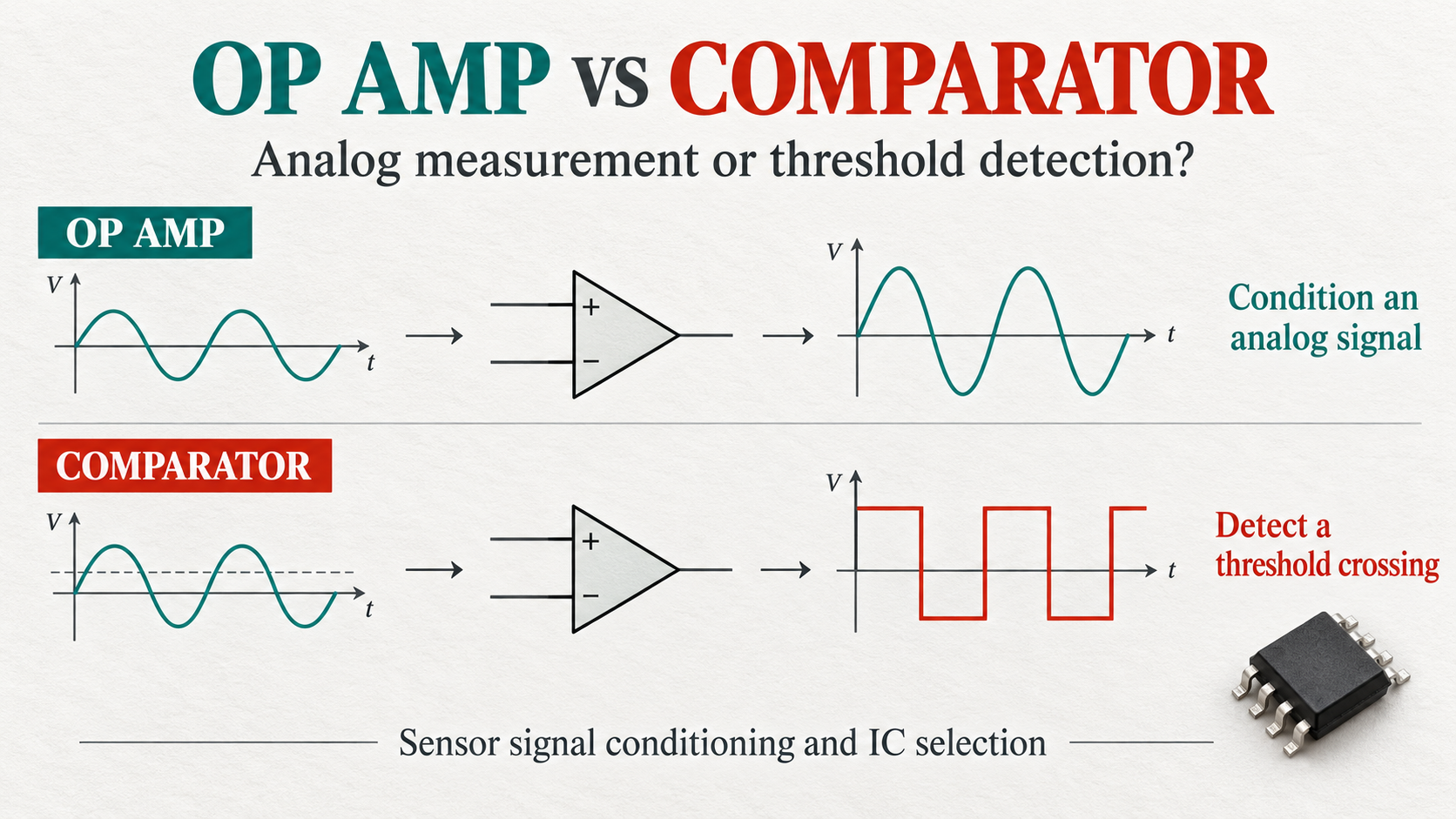
For example, a general-purpose amplifier and a comparator may look similar in a schematic but are designed for different operating roles. Our guide to op amps versus comparators explains what to check before using one in place of the other.
When a local store cannot find the exact part
If the local store does not have the exact component, do not immediately accept a substitute with a similar description. First decide whether the project needs an exact replacement or whether engineering-approved alternatives are acceptable.
For an exact replacement, keep the complete manufacturer part number unchanged and ask the supplier to quote that code specifically.
For an alternative, request a separate comparison that includes:
- Original and proposed manufacturer part numbers.
- Functional differences.
- Package and pinout comparison.
- Electrical specification differences.
- Operating temperature and lifecycle information.
- Any PCB, firmware or circuit changes required.
A similar package does not prove electrical compatibility. The replacement should be reviewed by the responsible engineer before it is added to an approved BOM.
When an online sourcing enquiry is more practical
An online enquiry may be more efficient than visiting several stores when you need an exact part number, multiple manufacturers, a larger quantity or a full BOM quotation.
EASYIEE lists electronic components across categories including integrated circuits, discrete semiconductors, optoelectronics, capacitors, resistors, connectors, sensors, relays, switches and inductors. You can also review the integrated circuit category or use the relay category to browse related component types.
For production requirements, include the complete BOM rather than sending only the most difficult line. A supplier may identify package inconsistencies, quantity risks or long-lead components that are not obvious from a single part search. Our BOM sourcing guide explains what information helps make a quotation easier to compare.
What to include in an electronic parts enquiry
A useful enquiry can be short, but it should contain enough information for the supplier to provide a meaningful response.
Example:
Please quote the exact manufacturer part number listed below for 500 units. Confirm available quantity, package, condition, packaging, estimated dispatch date and shipping options. List any alternatives separately and do not substitute without approval.
Add the following details where relevant:
- Manufacturer and complete part number.
- Required quantity and annual usage.
- Target delivery date.
- Exact part or alternative allowed.
- Package and packing requirement.
- Required documentation or inspection conditions.
- Destination country and shipping preference.
Find the right source for the actual requirement
If you need a common component immediately, a nearby electronics shop may be the fastest option. If you need a specific semiconductor, a hard-to-find memory device, an obsolete part or several BOM lines, physical distance is only one part of the decision.
The safer process is to identify the exact part number, verify the package and electrical requirements, confirm the quantity and lead time, and keep proposed alternatives separate from the original request.
Send EASYIEE your part number or BOM for a sourcing enquiry. Include the required quantity, delivery date and whether alternatives are acceptable. Availability, lead time, packaging and commercial terms should be confirmed for the specific enquiry before placing an order.